
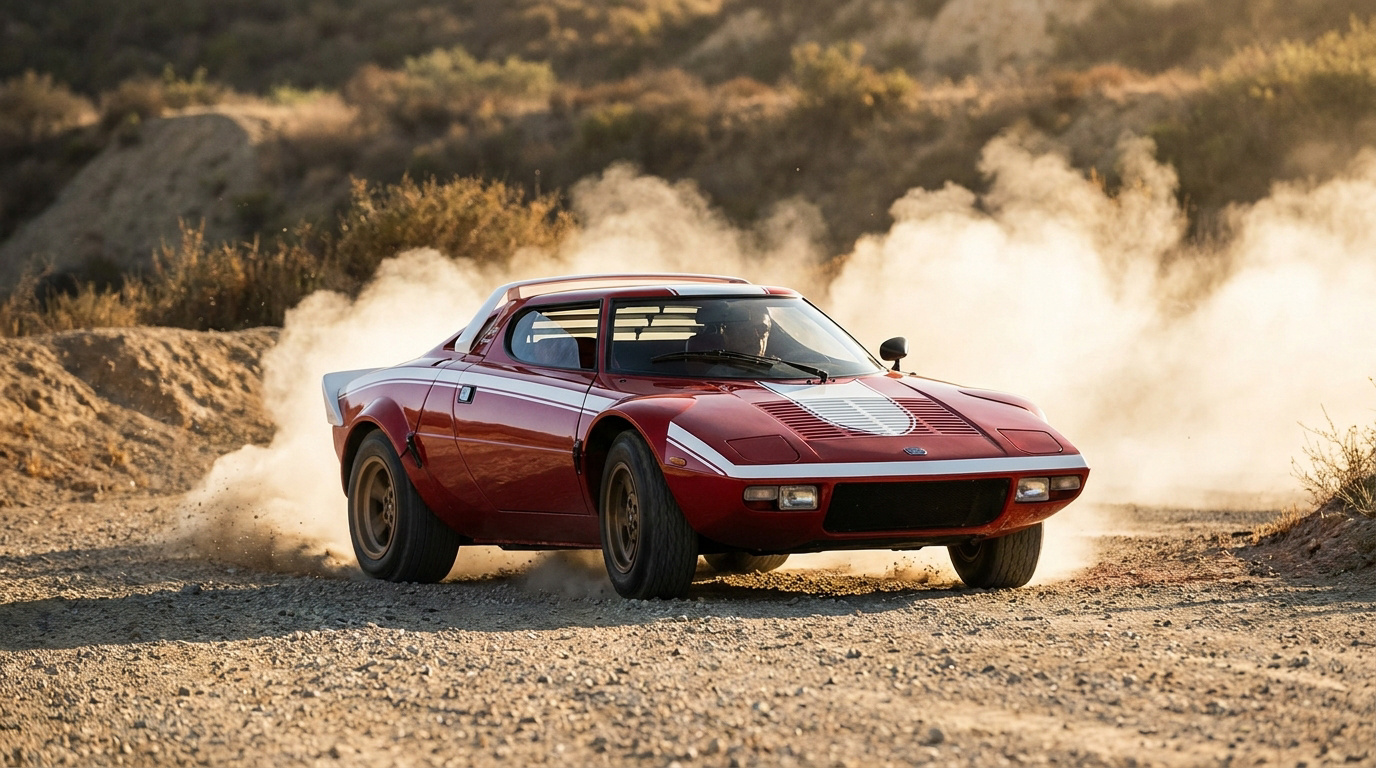
Key takeaway: The Lancia Stratos revolutionized motorsport as the first purpose-built rally weapon, securing three consecutive WRC titles from 1974 to 1976. By marrying a radical Bertone wedge design with a mid-mounted Ferrari Dino V6, it offered unmatched agility. This uncompromising masterpiece remains the ultimate benchmark for performance, proving that pure engineering focus can define a racing era.
With three consecutive World Rally Championship titles between 1974 and 1976, this machine remains the first car ever specifically engineered for the mud and gravel of international competition. Yet, finding a clear synthesis of the technical lancia stratos characteristics is often difficult amidst the mountain of motorsport myths.
I have analyzed the mechanical soul of this Bertone masterpiece to help you understand why its Ferrari-powered heart and radical geometry still dominate the dreams of every serious collector. Let’s break down the engineering secrets of this Italian wedge together.
- Fundamental Lancia Stratos Characteristics and Design Roots
- Engineering the Mid-Engine Heart with Ferrari Power
- Homologation Reality and the Group 4 Rally Dominance
- Privateer Efforts and the Jolly Club Influence
- Why was the Stratos Replaced by the Fiat 131 Abarth?
Fundamental Lancia Stratos Characteristics and Design Roots
The Lancia Stratos redefined rallying with its Ferrari Dino V6 engine, a radical 2,180mm wheelbase, and three consecutive WRC titles from 1974 to 1976. Its wedge-shaped Bertone design prioritized agility over stability, creating a mid-engine legend born from the Stratos Zero concept.
The transition from a futuristic showpiece to a ruthless stage-winning machine marks one of the most audacious chapters in automotive history.
From the Stratos Zero concept to production reality
I find the contrast between the 1970 Stratos Zero and the final HF version truly staggering. While the concept stood at a mere 84cm, Marcello Gandini envisioned a pure racing wedge that completely ignored traditional road car aesthetics.
The production car retained that radical 2,180mm wheelbase, built upon a rigid steel chassis. This “wedge” wasn’t just for show; it served high-speed aerodynamics, a testament to the genius of Marcello Gandini and Bertone.
Fiberglass body panels were chosen for the exterior. These lightweight materials were essential for the car’s power-to-weight ratio in Group 4.
In many ways, its uncompromising silhouette reminds me of the Lamborghini Countach design specs, another Gandini masterpiece that favored visual impact over utility.
Cockpit ergonomics and the reality of driver visibility
The panoramic windshield is a masterpiece of engineering. It offered incredible forward visibility for tight hairpins but created a claustrophobic greenhouse effect for the crew. We often forget the severe helmet clearance issues.
Inside, you will find door pockets designed specifically to hold rally helmets. The interior was a Spartan workspace, not a luxury cabin for grand touring, reflecting its brutal purpose.
The offset pedals and cramped legroom remain notorious. Every design choice favored the mid-engine layout over human comfort or standard ergonomics, proving that this was always a tool for speed first.
Engineering the Mid-Engine Heart with Ferrari Power
While the design turned heads, the real magic happened behind the driver where an Italian masterpiece provided the grunt.
Securing the Dino V6 through political maneuvering
Cesare Fiorio exhibited relentless persistence to secure the 2.4-liter V6. Enzo Ferrari initially hesitated, fearing he was arming a direct competitor capable of outshining his own Dino 246 GT on track.
The transverse engine mounting proved vital for the ultra-short wheelbase and optimal weight distribution. This specific orientation influenced future supercars significantly. You can check this maintenance cost guide to compare Ferrari engine upkeep requirements.
The Stradale version delivered a respectable 190 hp. This output felt immense in a machine weighing under 1,000 kilograms.
Evolution from 12-valve to 24-valve configurations
The jump from the 12-valve road engine to the 24-valve competition head was transformative. These racing versions reached nearly 300 hp, turning the Stratos into a terrifying force on gravel stages.
I must mention the rare turbocharged versions. These 560 hp monsters, built for Group 5 circuit racing, unfortunately suffered from notorious reliability issues and massive, unpredictable turbo lag during competition.
- Power output of Stradale: 190hp
- Power of 24V Rally: 275-300hp
- Power of Group 5 Turbo: 560hp
Overcoming early suspension and handling hurdles
Mike Parkes performed extensive work on the rear geometry. The initial prototype faced stability issues, requiring a complete rethink of the MacPherson strut setup to survive punishing, rough rally terrain.
The handling profile remains notoriously “nervous.” The short wheelbase allowed the car to rotate instantly, but it required a virtuoso behind the wheel to manage the “snap oversteer” and avoid a spin. It was never for amateurs.
The central steel tub provided a solid foundation. This rigidity was essential for supporting the heavy-duty racing suspension components.
Homologation Reality and the Group 4 Rally Dominance
Engineering excellence is nothing without the trophies to prove it, and Lancia had to jump through hoops to enter the fray.
The struggle to reach the 400-unit production mark
FIA Group 4 rules were uncompromising. Lancia had to produce 400 units, a staggering challenge for a cockpit-sized wedge with zero luggage space and absolutely no practical utility for daily consumers.
| Feature | Stradale (Road) | Group 4 (Rally) |
|---|---|---|
| Body Material | Fiberglass/Steel | Fiberglass/Steel |
| Horsepower | 190hp | 300hp |
| Weight | 980kg | 880kg |
| Transmission | 5-speed manual | 5-speed manual |
| Purpose | Road use | WRC |
Build quality was often secondary. Many Stradale units were finished hastily simply to meet the FIA’s strict production deadlines.
Three consecutive years of World Rally Championship glory
Between 1974 and 1976, this machine simply owned the dirt. It was the first purpose-built rally weapon, effectively ending the era of modified production sedans on the world stage.
Sandro Munari, famously known as “The Dragon,” mastered the car’s notoriously twitchy mid-engine behavior. His precision led to legendary, dominant victories at the prestigious Monte Carlo Rally.
While competitors like the Porsche 911 fought hard, the Stratos remained the undisputed king of the mid-seventies rally scene.
Iconic liveries that defined the Alitalia era
The Alitalia green, white, and red scheme is legendary. It remains the most recognizable livery in motorsport history, perfectly hugging the car’s aggressive, sharp geometric lines.
Strategic partnerships with Marlboro and Pirelli followed. These alliances provided the massive budgets required for international logistics and constant technical development. The Alitalia livery remains the fan favorite.
The media impact was instantaneous. These striking visuals ensured the Stratos appeared on every bedroom poster and television screen across the globe.
Privateer Efforts and the Jolly Club Influence
Even when the factory team moved on, the Stratos refused to die thanks to dedicated privateers who kept the fire burning.
How Jolly Club and Grifone expanded the racing reach
The Jolly Club and Grifone squads were instrumental in maintaining the Stratos’s dominance. These private outfits proved the car’s longevity, winning European championships long after the official Lancia squad had focused elsewhere.
I believe customer racing was the true backbone of this legend. By selling chassis to private teams, Lancia ensured a massive grid presence. This strategic move solidified the car’s reputation for reliability and speed across various international stages.
Technical support remained surprisingly robust behind the scenes. Lancia engineers often worked “under the table” to help these teams maintain their Ferrari-powered machines.
- Jolly Club: Key privateer team
- Grifone: Specialized in Italian rallies
- Chardonnet: Dominant in French rally events
Driving characteristics of the road-going Stradale version
The Stradale offers raw mechanical feedback that modern cars simply cannot replicate. There is no power steering or brake servo; every input requires physical effort and rewards the driver with unfiltered precision.
And since I am talking about sound, the soundtrack is absolutely legendary. The Dino V6 screams directly behind your head, separated only by a thin pane of glass. It is a visceral, deafening, and intoxicating experience.
How does it compare to today’s standards? While a Tesla Model Y is faster in a straight line, it lacks the soul and terrifying engagement of a Stratos.
The total lack of driver aids defines the experience. No ABS or traction control means your right foot is the only computer.
Why was the Stratos Replaced by the Fiat 131 Abarth?
Success on the track wasn’t enough to save the Stratos from the cold, hard logic of corporate marketing departments.
Internal politics and the shift toward mass-market marketing
Fiat’s commercial strategy shifted focus toward volume. They prioritized winning with models resembling showroom cars, specifically the 131 sedan, to directly stimulate consumer sales across their global dealership networks.
I believe the tension between Lancia’s racing purity and Fiat’s bottom line was inevitable. The Stratos was far too unique; it simply didn’t help sell sensible family cars to average buyers.
The Alitalia partnership ended abruptly. This sponsorship shift perfectly coincided with the official move to the Fiat 131 Abarth.
The New Stratos and modern carbon-fiber reinterpretations
The 21st-century “New Stratos” project remains a personal favorite. Built on a shortened Ferrari 430 Scuderia chassis, it successfully captured Gandini’s original wedge essence using modern, lightweight carbon fiber.
We must also mention the 2005 Fenomenon concept. Such tributes prove that this radical design language remains deeply relevant and inspiring for contemporary automotive designers and high-end collectors alike.
Check out this comparison of sports icons to see how other legends evolved over the decades.
Transformers and the lasting impact on pop culture
Wheeljack from the Transformers franchise is a standout. The Stratos’ distinct, futuristic shape made it the perfect choice for a heroic robot, forever cementing its status in children’s minds.
Today, its presence in simulators like Gran Turismo is vital. Younger generations now experience the car’s notoriously difficult handling through precise digital recreations of those legendary, high-stakes historic rallies.
The Stratos remains the ultimate, uncompromising benchmark for rally car design. It represents a rare moment where engineering and art collided without any corporate filters.
Mastering the Lancia Stratos characteristics requires embracing its brutal V6 Ferrari power and radical short wheelbase. This purpose-built rally weapon remains an unparalleled icon of performance and Gandini’s visionary design. Experience this mechanical masterpiece now, as its legendary soul continues to define the ultimate driving dream.