
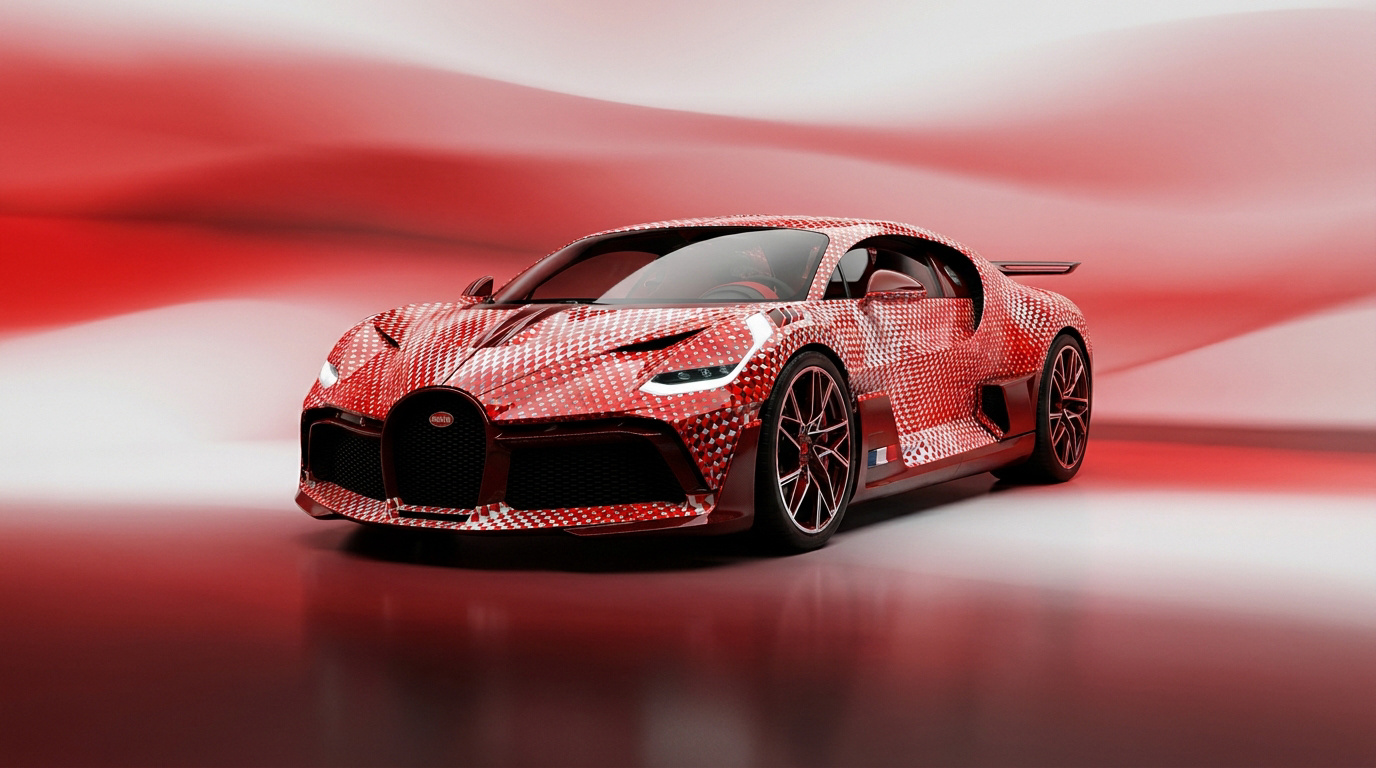
Key takeaway: The Bugatti Divo “Lady Bug” represents the pinnacle of modern coachbuilding, demanding 1.5 years of algorithmic precision to master a complex geometric pattern. By solving 2D distortion on 3D surfaces, Bugatti’s team flawlessly applied 1,600 diamonds. This zero-defect masterpiece proves that bespoke engineering can transform a 1,500 hp hypercar into an incomparable work of automotive art.
Can a geometric pattern consisting of 1,600 individual diamonds truly be applied to the sculptural curves of a hypercar without a single millimeter of distortion? This was the monumental challenge posed by a US collector, pushing the boundaries of what we thought possible in modern coachbuilding.
The technical reality of mapping a 2D motif onto the complex 3D body of the bugatti divo ladybug almost forced the design team to abandon the project entirely. I will explain how Bugatti overcame these algorithmic hurdles and why this eighteen month journey resulted in an incomparable masterpiece of automotive art.
- Why the Bugatti Divo Ladybug Redefines Modern Coachbuilding
- How Bugatti Solved the 2D Pattern Distortion on a 3D Body
- 3 Reasons Why the Painting Process Took Over 18 Months
- Engineering Specs and the Final Delivery of a Masterpiece
Why the Bugatti Divo Ladybug Redefines Modern Coachbuilding
The Bugatti Divo “Lady Bug” is a unique one-off hypercar featuring a complex geometric diamond pattern. This bespoke project took 1.5 years to complete, requiring algorithmic precision to apply 1,600 diamonds across the vehicle’s concave surfaces starting with the initial customer vision.
The transition from a standard limited series to this specific masterpiece required a level of dedication that honestly borders on the obsessive.
The Collaborative Spark with a US Collector
A US collector requested a strict geometric motif with high-contrast colors. Designers met the client multiple times to refine this ambitious vision. The goal was a truly unique aesthetic.
Molsheim’s team then translated these ideas into technical reality. Early sketches focused on how to align diamonds on curves. Brainstorming sessions tested the limits of feasible design.
This joint creative process saw the client involved in every single decision. Such a close partnership pushed the boundaries of traditional vehicle customization. In fact, it redefined what we expect from bespoke aesthetics.
Honoring the Heritage of Ettore Bugatti
The “Lady Bug” perfectly embodies Ettore Bugatti’s philosophy of incomparable automotive art. It is a technical masterpiece. Every detail reflects a commitment to creating something truly unique and beautiful.
Within the limited production of forty Divo units, this one-off stands alone. While every Divo is rare, this specific car represents the absolute pinnacle of exclusivity. It is a collector’s dream, frankly.
Everything Bugatti creates is a piece of art, but the Lady Bug represents the absolute limit of what our craft can achieve.

How Bugatti Solved the 2D Pattern Distortion on a 3D Body
Moving from the philosophical heritage to the workshop floor reveals the massive technical hurdles the engineers faced.
Algorithmic Precision for 1,600 Diamond Shapes
Mapping 2D shapes onto 3D concave surfaces proved a nightmare. The carbon fiber body’s sculptural curves risked massive visual distortion. Every geometric element threatened to warp unnaturally.
CAD modeling became our essential essential digital savior. The team simulated the placement of every single diamond. This digital foundation was necessary before any physical work could begin on the hypercar.
Precision here rivals the maintenance requirements of luxury cars. Even tiny misalignments ruin the aesthetic flow.
From Digital Models to Physical Test Mules
We used six-meter transfer films for testing. These were applied to prototype vehicles first. This step verified the pattern’s alignment across different body panels effectively.
Millimeter-level adjustments were mandatory throughout the process. Even a tiny error would cause the diamonds to look warped. The team spent weeks refining the physical application.
To ensure a zero-defect finish, we relied on a rigorous validation sequence:
- Use of test mules
- Application of transfer films
- Manual adjustment of diamond edges
- Final digital verification
3 Reasons Why the Painting Process Took Over 18 Months
While the digital mapping was hard, the actual painting process proved to be an even greater test of patience.
The Psychological Weight of the Zero-Defect Strategy
The Color and Trim department felt a heavy burden. They lived with the constant risk of total project failure. One tiny slip-up meant starting the entire car over.
Early attempts simply failed the strict “zero-defect” test. The team struggled to find the mental strength to continue. They actually had to restart the full process several times.
There were moments where we thought the pattern was impossible to achieve without flaws.
Layering Customer Special Red and Graphite
Our team developed two specific metallic shades for this project. We focused on Customer Special Red and Graphite to create contrast. These colors define the unique “Lady Bug” identity.
The multi-layer application was incredibly demanding. This technique provides a ruby-like brilliance and immense depth. Each layer required perfect uniformity across the Divo’s sculptural bodywork.
| Layer Type | Purpose | Duration |
|---|---|---|
| Base coat | Apply Customer Special Red effect | Initial phase |
| Pattern application | Align 1,600 diamonds manually | Several weeks |
| Clear coat | Seal design and add depth | Intermediate phase |
| Final Polish | Achieve zero-defect brilliance | Two weeks plus |
Engineering Specs and the Final Delivery of a Masterpiece
After the paint dried, the focus shifted to the finishing touches and the raw power hidden beneath the skin.
Manual Finishing and the Final Two-Week Polish
Expert painters in Molsheim performed the ultimate sanding stages. They meticulously smoothed every inch of the bodywork. The surface had to be perfectly tactile for the owner.
The client’s emotional reaction was truly profound. Seeing the completed vehicle for the first time was a powerful moment. The 1.5-year wait finally came to an end.
Hand-finishing alone required two weeks of constant work. This ensured the transition between colors was seamless to the touch. It was a real technical claque.
Performance Metrics of the 1,500 hp W16 Engine
The Divo features an 8-liter W16 engine. It delivers a massive 1,500 hp output. The top speed is electronically limited to 380 km/h. This machine is a brute technique.
A 5 million euro base price reflects its rarity. This unique customization adds immense value to the car. It transforms a hypercar into a unique collector’s asset.
This Divo remains a mechanical beast. Its beauty does not compromise extreme performance.
The Bugatti Divo Ladybug stands as a triumph of bespoke engineering, harmonizing a 1,500 hp W16 engine with 1,600 meticulously aligned geometric diamonds. This 18-month masterpiece proves that automotive art knows no limits. Secure your place in history by embracing such uncompromising craftsmanship today.